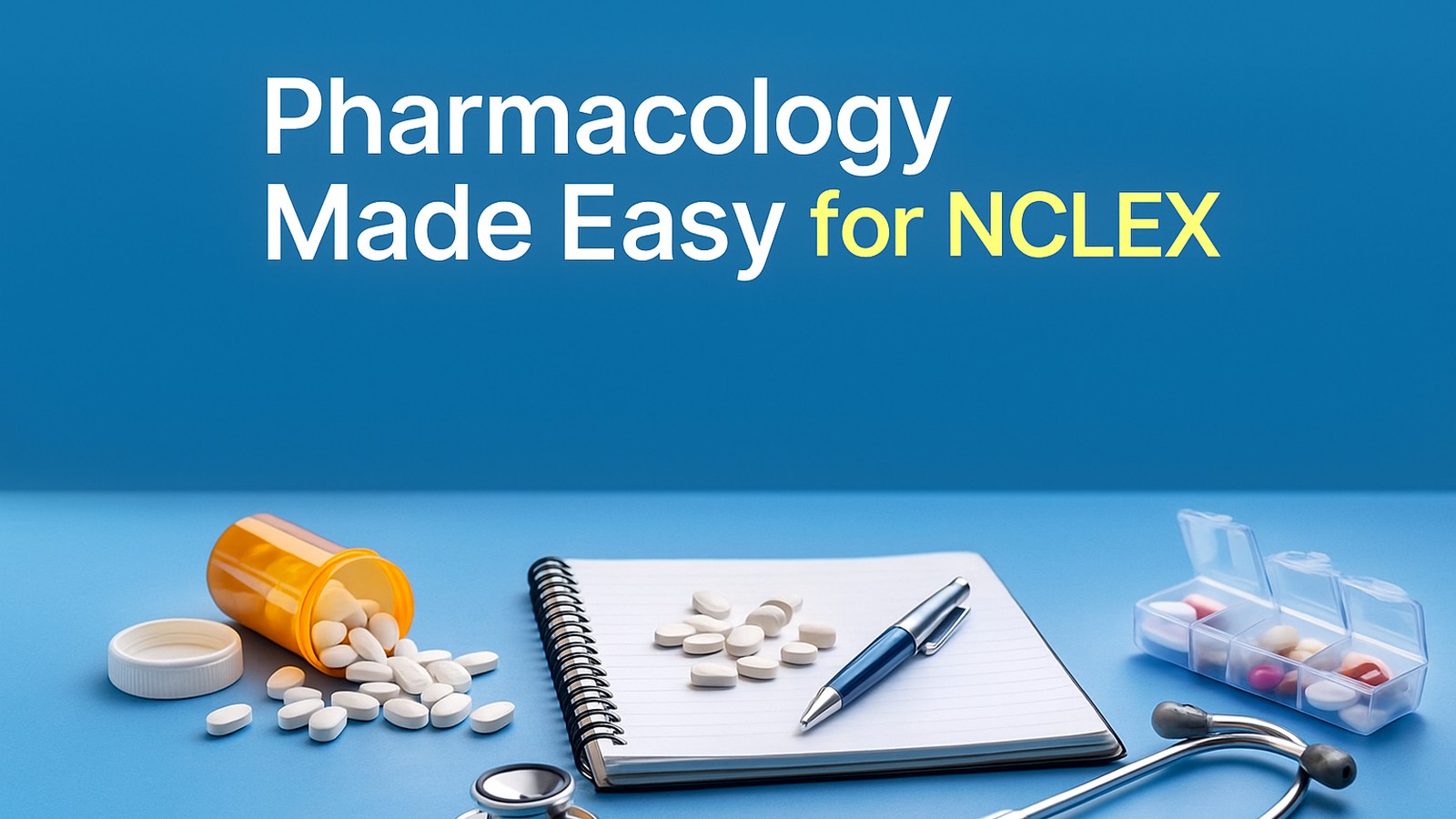
Pharmacology is one of the most tested—and most intimidating—NCLEX areas. The good news? You don’t need every drug memorized. Focus on high-yield classes, safety-first nursing actions, and pattern recognition. Use NGN-style practice to train your clinical judgment and you’ll walk in confident.
Core drug classes & nursing actions
Cardiovascular
ACE inhibitors (-pril: lisinopril, enalapril)
-
Check BP before/after; watch dry cough, hyperkalemia.
-
Red flag: facial/tongue swelling (angioedema) → emergency.
-
Teach: rise slowly; avoid potassium salt substitutes.
Beta-blockers (-lol: metoprolol, atenolol, propranolol)
-
Take apical pulse 1 full minute; hold if <60 bpm (per policy).
-
Monitor BP; can mask hypoglycemia.
-
Teach: never stop abruptly (rebound tachy/HTN).
Calcium channel blockers (amlodipine, diltiazem, verapamil)
-
Monitor HR/BP, edema; constipation (verapamil).
-
Teach: avoid grapefruit juice; change positions slowly.
Fluids & electrolytes
Loop diuretics (furosemide, bumetanide)
-
Daily weights, I&O; check K⁺/Na⁺, BUN/Cr; orthostasis.
-
Teach: take AM; eat K⁺ foods; report cramps/weakness.
Thiazides (HCTZ, chlorthalidone)
-
Watch hypokalemia, hyponatremia, ↑uric acid, ↑glucose.
-
Photosensitivity precautions.
Anti-infectives (principles)
-
Verify allergies; obtain cultures before first dose.
-
Monitor for superinfection (C. diff, thrush).
-
Finish the entire course; report rash or hives.
Class cues:
-
Penicillins (-cillin): allergy risk; some on empty stomach.
-
Macrolides (-mycin): check LFTs, interactions.
-
Fluoroquinolones (-floxacin): tendon rupture risk; no dairy/antacids around dose.
-
Aminoglycosides (gentamicin): nephro-/ototoxic → monitor levels, hearing, kidneys.
High-alert meds (extra vigilance)
Insulin
-
Double-check dose & type; insulin syringe only.
-
Check glucose pre/post; have glucagon available.
-
Signs of hypoglycemia: shaky, sweaty, confused, tachy.
Anticoagulants
-
Heparin: monitor aPTT (goal ≈1.5–2.5×), platelets (HIT). Antidote protamine.
-
Warfarin: monitor INR (goal 2–3), interactions; consistent vitamin K. Medical ID.
Opioids
-
Check RR & sedation; hold if RR <12 (per policy). Antidote naloxone.
Digoxin
-
Apical pulse 1 min; hold if HR <60 adults (<90–110 pedi).
-
Therapeutic 0.8–2.0 ng/mL; toxicity: yellow-green halos, N/V, brady/arrhythmias.
Memory aids (quick wins)
-
ACE → the HACK: Hyperkalemia, Angioedema, Cough, Kidney (AKI risk).
-
Beta-blockers: “LOL slows the soul.” Check HR/BP.
-
Digoxin: VAIN → Visual changes, Arrhythmias, Intestinal upset, Neurologic.
Suffix map (spot the class fast):
-pril (ACE-I), -sartan (ARB), -lol (beta-blocker), -dipine (DHP CCB), -statin (lipids), -prazole (PPI), -pam/-lam (benzos), -azole (antifungal), -cillin/-mycin/-floxacin (antibiotics).
Test strategy (NGN-ready)
-
Prioritize safety: hold/assess when vital signs are unsafe or red-flag effects appear.
-
Read stems for “priority/initial/best”—address airway, perfusion, toxicity first.
-
In SATA, treat each option true/false independently.
-
For calc/fill-in: label units; re-check plausibility.
NCLEX-style mini-set (practice now)
-
A client on lisinopril reports swollen lips and difficulty swallowing. Priority action?
A. Provide lozenges
B. Administer PRN acetaminophen
C. Hold drug and notify provider immediately
D. Encourage fluids
Correct: C -
Before giving metoprolol, which assessment is essential?
A. Blood glucose
B. Bowel sounds
C. Respiratory rate
D. Apical pulse for 1 minute
Correct: D -
Which finding requires urgent action in a client on furosemide?
A. 1 lb weight loss in 24 hr
B. Potassium 2.9 mEq/L
C. Mild dizziness on standing
D. Sodium 135 mEq/L
Correct: B -
Teaching for warfarin should include:
A. Increase kale intake for better effect
B. Skip INR checks if you feel well
C. Keep vitamin K intake consistent and monitor INR
D. Take ibuprofen freely for pain
Correct: C -
A client on digoxin has N/V and sees yellow halos. First action?
A. Give next dose early
B. Hold dose and check serum level/EKG
C. Encourage fluids
D. Administer ondansetron and continue therapy
Correct: B
Further Reading
-
High-Alert Medications: Safety Playbook
Reference
Related blogs
Recent posts