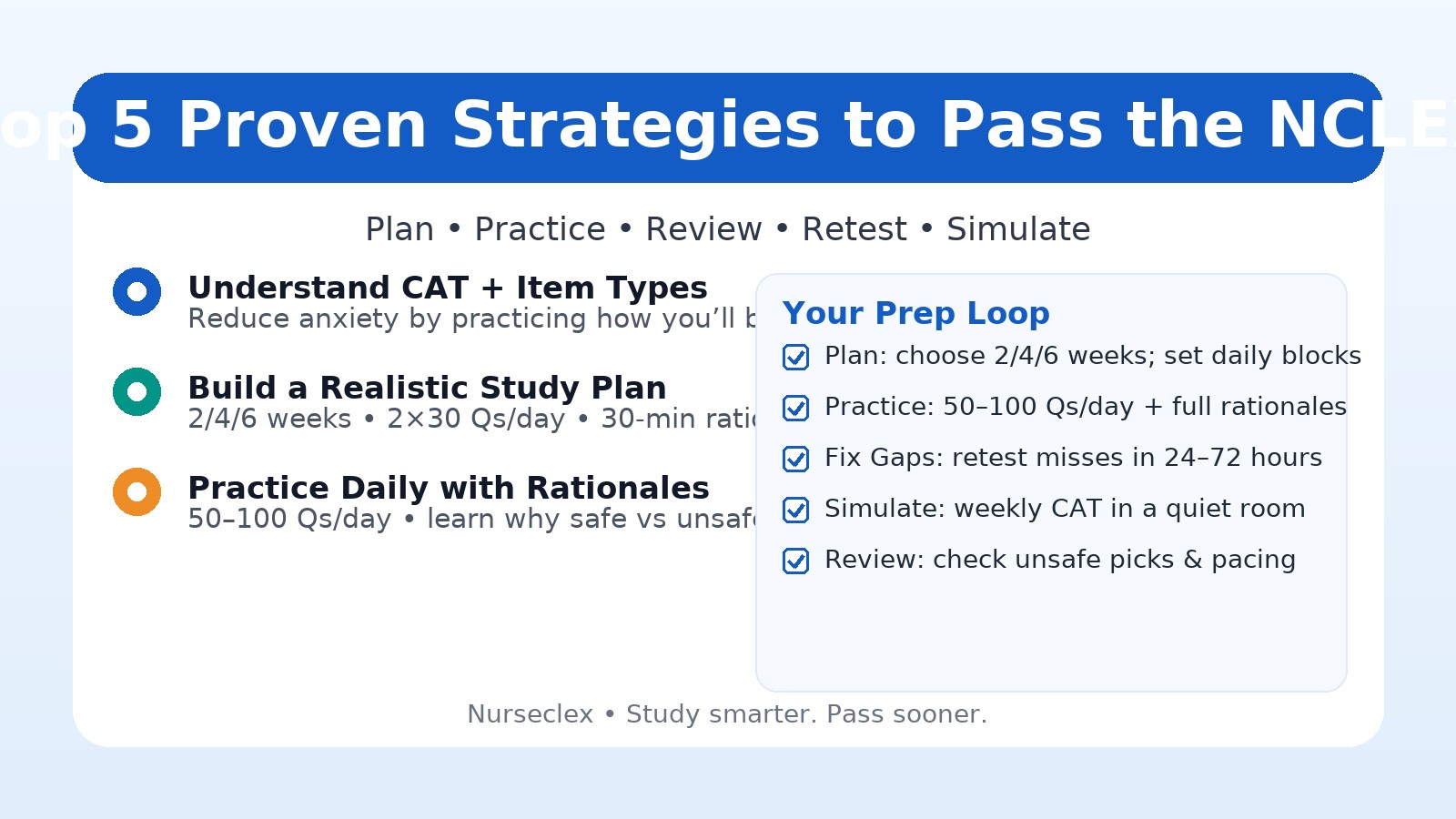
Preparing for the NCLEX can feel overwhelming—but with the right approach, you can pass the NCLEX on your first attempt and start your career with confidence. Use this five-step plan to study smarter, build clinical judgment, and walk into test day calm and ready.
1) How to pass the NCLEX: Understand the format (CAT + item types)
The NCLEX uses Computerized Adaptive Testing (CAT). Question difficulty changes with your performance, so you’ll see a mix of easier and harder items as the exam hones in on your competence line. Knowing this reduces anxiety and guides your practice.
What to know:
-
CAT means precision over volume: it’s about consistent safe choices, not answering every possible topic.
-
Expect classic and NGN types: multiple choice, SATA, ordered response, drag-and-drop, hot spot, matrix, cloze, and case sets.
-
Practice in conditions that resemble CAT to make exam day feel familiar.
Related read: CAT Simulation (nurseclex.com/homeblogs/cat-sim)
2) Build a realistic study plan you’ll actually follow
One size doesn’t fit all. Choose 2, 4, or 6 weeks and make a plan that reflects school, work, and life.
Daily structure that works:
-
Blocks: 2×25–30 questions + 30 minutes of rationales.
-
Error log: Track misses by topic and reason (content gap, strategy, or careless).
-
Spaced review: Revisit weak spots within 24–72 hours to lock learning.
-
Rest: 1 day per week to prevent burnout.
Grab a template: Study Plans (nurseclex.com/homeblogs/study-plans)
3) Practice every day—with rationales that teach
To pass the NCLEX, daily question practice is non-negotiable. Reading notes alone won’t build clinical judgment or stamina.
How to practice:
-
Aim for 50–100 questions/day, mixing systems (cardio, resp, neuro) with safety and pharm.
-
Read every rationale: why the correct option is safe and why others are unsafe/out-of-scope.
-
Re-test misses in short sets (10–15 questions) after your review window.
Start here: QBank Hub (nurseclex.com/homeblogs/qbank)
4) Focus on the high-yield topics that move your score
Not all content is equal. Prioritize areas repeatedly tested for safety and judgment:
-
Pharmacology (prototypes, adverse effects, monitoring, interactions) →
-
Prioritization & Delegation (RN vs LPN vs UAP scope; stable vs unstable) →
-
Pediatrics & Maternal (age-appropriate care, development, postpartum priorities)
Use your analytics to target the lowest-performing domains first—that’s the fastest route to score gain.
5) Simulate the real exam to build pacing and confidence
Full-length, timed CAT simulations train focus and reveal weak habits (rushing stems, skipping re-reads, second-guessing safe answers).
How to run great sims:
-
Quiet room, one sitting, no notes.
-
Take at least two full CAT simulations in your final 2–3 weeks.
-
Post-sim review: highlight unsafe picks, repeated misses, and any speed/accuracy trade-offs. Turn findings into the next week’s plan.
Mini strategy checklist (print this)
-
ABCs → Safety → Stability → Time-sensitive to rank priorities.
-
ADPIE (assess → diagnose → plan → implement → evaluate) to spot which step the item tests.
-
Eliminate unsafe/out-of-scope choices first; bank partial credit where applicable.
-
If two answers look right, choose the safer first action.
-
After an action, ask: What will I reassess to confirm it worked?
One-week tune-up (plug into any timeline)
-
Mon–Thu: 2×30 mixed Qs; 30–45 min rationales; 10-min error log
-
Fri: 75-item mixed quiz; quick content refresh on top two weak areas
-
Sat: NGN case set + targeted pharm review
-
Sun: Rest or light skim (30 min); set goals for Monday
Common pitfalls (and quick fixes)
-
Over-studying favorites → Fix: schedule hard topics first while you’re fresh.
-
Skipping rationales → Fix: write one-line “never again” rules.
-
No sims → Fix: weekly CAT in the last half of your plan.
-
Burnout → Fix: protect rest days; shorter, sharper sessions beat marathons.
Related blogs





Recent posts