The NCLEX (National Council Licensure Examination) is more than a test—it’s the gateway to nursing practice in the U.S. and Canada. Whether you’re pursuing RN or LPN/LVN, passing the NCLEX proves you’re ready to deliver safe, effective, compassionate care.
At Nurseclex, understanding why the NCLEX exists helps you study with purpose—so you can prepare strategically and pass with confidence.
Why the NCLEX exists
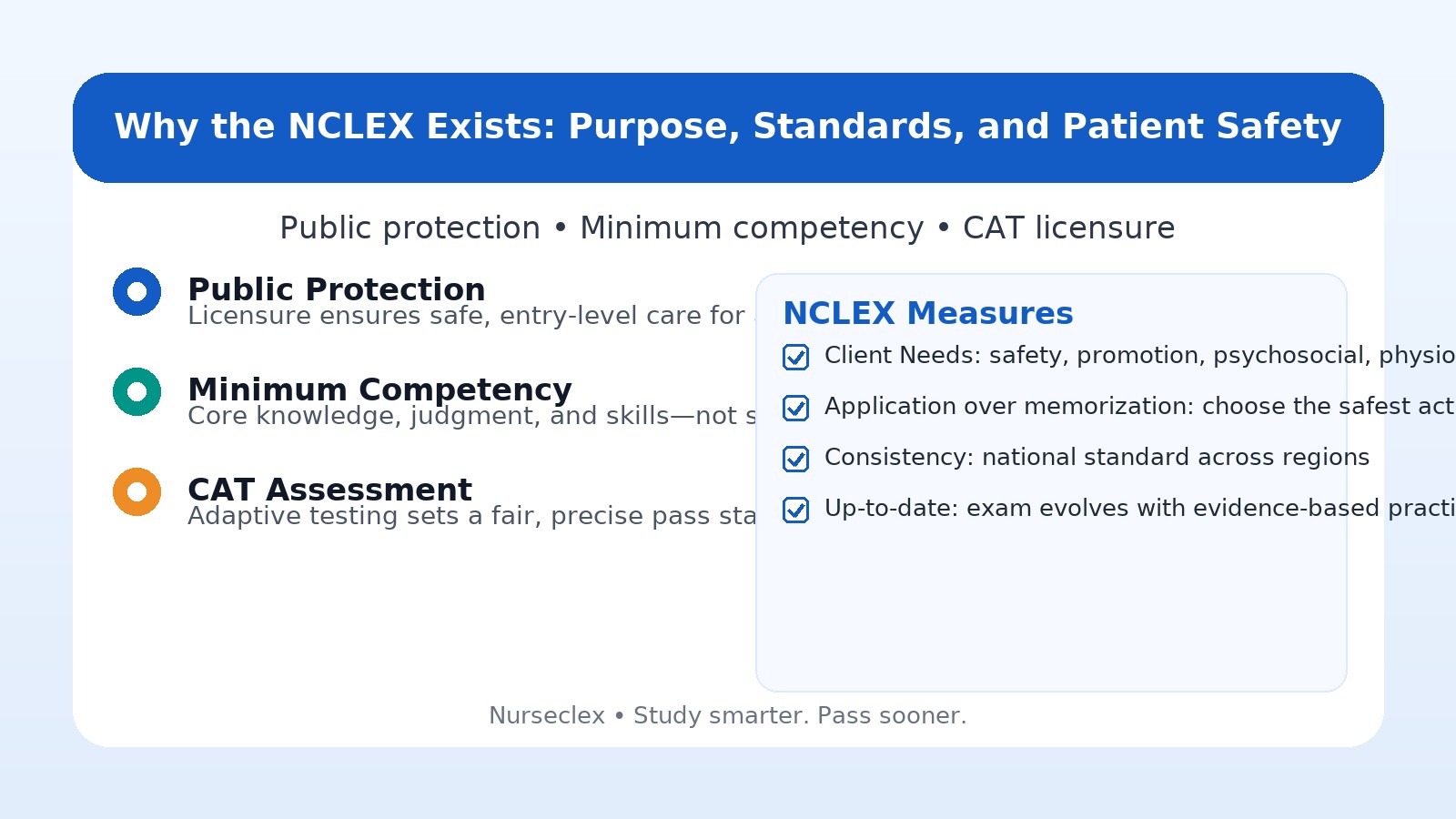
1) Public protection is the primary goal
The NCLEX acts as a safety filter: only candidates who demonstrate minimum competency earn a license. Patients, families, and employers can trust that licensed nurses meet a national baseline for safe practice.
2) Defining minimum competency
“Minimum competency” means the essential judgment, knowledge, and skills required for entry-level, safe nursing care. The exam does not test advanced specialties; it focuses on core nursing practice that every new nurse must master.
3) Licensure requirement
In the U.S. and Canada, nursing school graduation alone doesn’t grant the right to practice. Passing the NCLEX is mandatory before you can legally work as an RN or LPN/LVN.
How the NCLEX measures nursing competency
Client Needs framework
The test blueprint maps to real nursing responsibilities:
-
Safe and Effective Care Environment (prioritization, safety, infection control)
-
Health Promotion and Maintenance (growth & development, prevention, education)
-
Psychosocial Integrity (mental health, coping, support)
-
Physiological Integrity (physical care, pharm, acute/chronic conditions)
Scenario example: Rather than asking for a normal lab value, an NCLEX item may present diuretic use + muscle weakness + irregular rhythm and ask which lab is most concerning—forcing you to apply knowledge and prioritize safety.
Application over memorization
Most items are scenario-based. Multiple choices may be “right,” but your task is to select the best priority action—mirroring real bedside decisions.
Computerized Adaptive Testing (CAT)
The exam adapts to you: correct answers bring more difficult items; misses bring easier ones. The test ends when the algorithm determines whether your performance is above or below the passing standard.
The role of the NCLEX in nursing standards
Consistency across regions
All newly licensed nurses meet the same national standard, supporting quality care in every state and province.
Evidence-based and up-to-date
The NCLEX is regularly updated to reflect current practice, so new nurses begin with modern, research-aligned knowledge.
Foundation for lifelong learning
Passing the NCLEX launches your career and sets a base for specialization, certifications, and advanced practice.
Benefits of the NCLEX
For patients: Confidence in safe, consistent, evidence-based care.
For employers: Assurance that new hires meet a verified skill standard.
For the profession: Stronger credibility, trust, and public protection.
How to prepare—and pass—with purpose
1) Use effective study strategies
2) Identify strengths and weaknesses
-
Take a diagnostic to find gaps.
-
Double down on weaker domains while maintaining your strengths.
3) Prioritize well-being
-
Sleep, hydration, and movement improve memory and focus.
-
Use spaced practice instead of cramming.
4) Build test-taking skills
-
Eliminate distractors; favor safety-first actions.
-
Drill SATA and NGN item types.
-
Take timed sets to build stamina.
Deepen content: Analysis & Prioritization and Pharmacology 2025
Final thoughts: Why the NCLEX exists—and why that matters to you
The NCLEX isn’t “just another exam”—it’s a professional safeguard that protects patients and ensures all new nurses meet a national standard of safety. For you, passing means more than a license: it’s proof you’re ready to make sound, compassionate, evidence-based decisions from day one.
When you study with purpose—grounded in why the NCLEX exists—you learn to think like a safe, entry-level nurse. Ready to start? Explore Nurseclex guides, QBank, and CAT simulations to study smarter and pass with confidence.
Related blogs
Recent posts