How the Next Gen NCLEX Is Different: Key Changes Explained
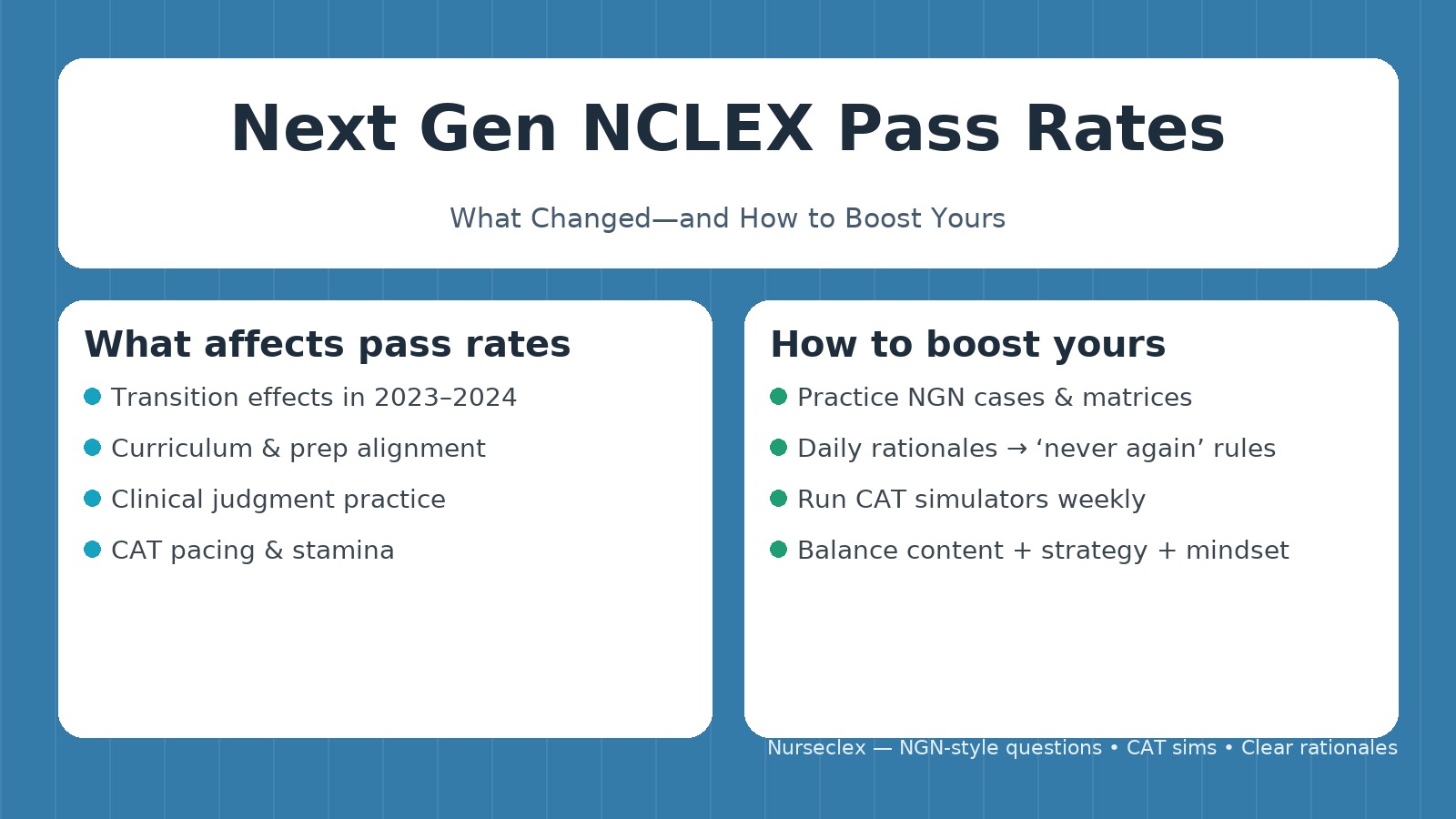
The Next Gen NCLEX (NGN) isn’t just a refresh—it’s a shift toward measuring clinical judgment in real-world scenarios. If you’re comparing the classic NCLEX to the new format, this guide breaks down the next gen NCLEX differences, the new item types, and how scoring works, plus quick prep tips to help you pass.
1) The biggest change: clinical judgment front and center
NGN maps every question to the NCSBN Clinical Judgment Measurement Model (CJM). You’ll be asked to:
-
Recognize cues,
-
Analyze findings,
-
Prioritize hypotheses,
-
Plan & implement actions, and
-
Evaluate outcomes.
Why this matters: rote recall alone won’t carry you. Questions reward the ability to think like a safe, entry-level nurse.
2) New NGN item types (with examples)
Expect a mix of interactive formats wrapped in case-based context:
-
Case Studies (6-item sets): Navigate a patient scenario across multiple CJM steps.
-
Bow-Tie Items: Identify the problem, best actions, and monitoring cues in one structured view.
-
Matrix / Multiple-Response (Row-by-Row): Judge each statement as true/false across categories (often with partial credit).
-
Drop-Down (Rationale / Cloze): Select the correct reasoning or term in-line with a sentence or chart.
-
Highlight Text / Table: Mark only the relevant cues from notes, hand-off reports, or flowsheets.
-
Trend Items: Decide if the patient is improving, stable, or deteriorating based on changing data.
Tip: Practice identifying priority cues before you choose an action. That’s the fastest way to improve accuracy on NGN.
3) Scoring is more forgiving: partial credit
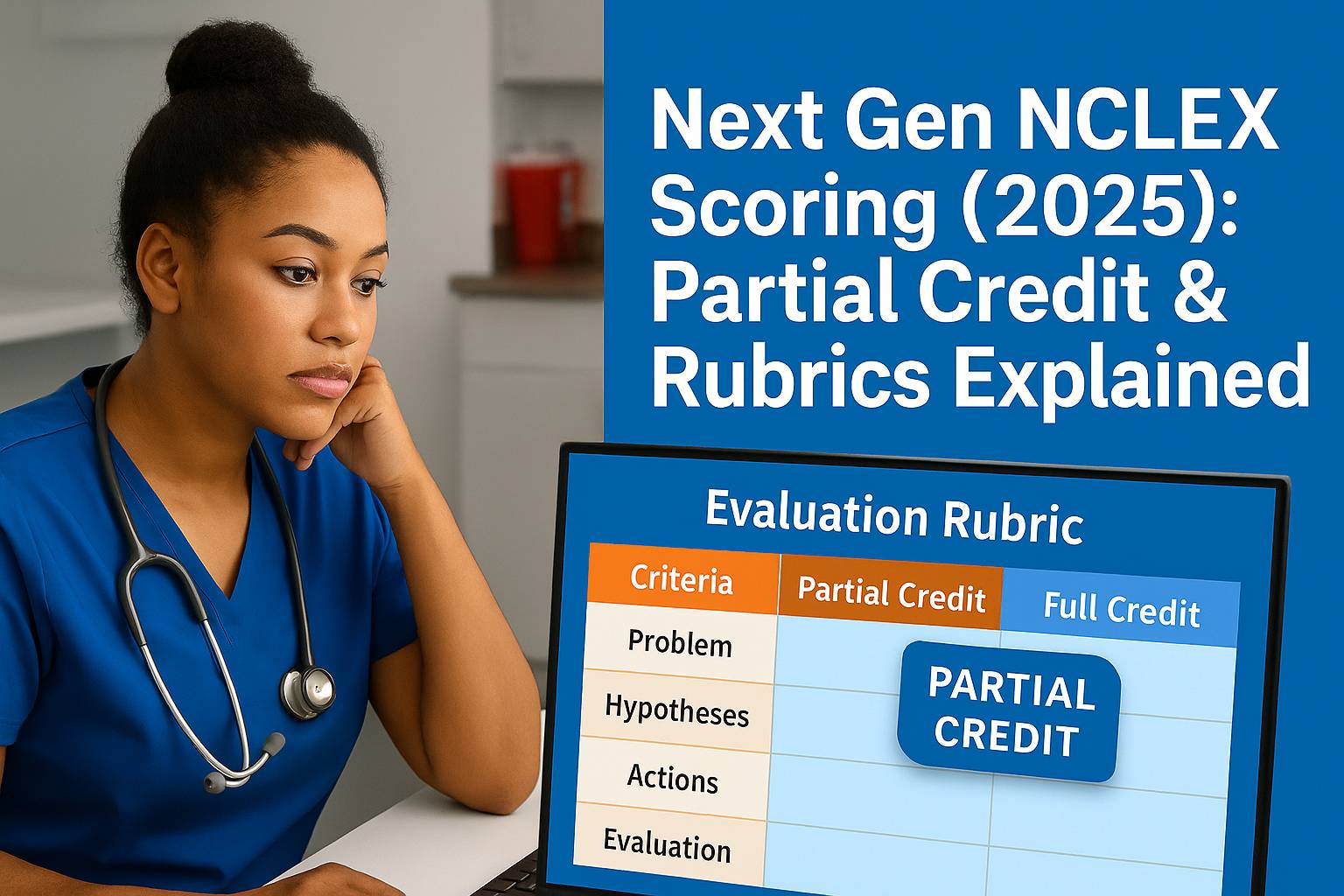
Unlike the old “all-or-nothing,” many NGN items award partial credit. You can earn points for getting some components right (e.g., several rows in a matrix), even if you miss others. This better reflects real clinical reasoning and can boost your overall ability estimate.
4) CAT still drives the test
NGN still uses Computerized Adaptive Testing (CAT). As you answer, the exam adjusts the difficulty to target your true ability relative to the passing standard. Your goal isn’t a raw score—it’s demonstrating consistent, safe performance across the blueprint.
5) What hasn’t changed (but students worry about)
-
The nursing blueprint remains: Safe & Effective Care, Health Promotion, Psychosocial, and Physiological Integrity—now with stronger clinical-judgment emphasis.
-
You’ll still see classic formats (e.g., standard multiple-choice/SATA) mixed with NGN items.
6) How to prepare for NGN (what actually moves the needle)
-
Practice case-based questions daily. Build speed recognizing relevant vs. irrelevant data.
-
Work backward from safety. Ask: “Which action reduces the greatest risk right now?”
-
Use rationale-rich review. Always read why an answer is right/wrong to reinforce CJM steps.
-
Simulate the interface. Get comfortable with drag-and-drop, highlight, and matrix layouts.
Try this quick workflow:
-
Skim the stem and patient goal,
-
Scan vitals/labs for red flags (Airway/Breathing/Circulation, infection, neuro changes),
-
Mark priority cues,
-
Choose the safest first action (assess vs. implement),
-
Validate with CJM logic.
7) Rapid FAQ (NGN keywords included)
Is the Next Gen NCLEX harder?
It’s different. Items reward clinical judgment more than memorization. With targeted practice, many students perform better thanks to partial-credit scoring.
Do all items give partial credit?
No. Many NGN formats do; some still score as all-or-nothing.
Are there more questions now?
The exam remains adaptive; question counts and time vary. Focus on ability, not totals.
How should I study for NGN item types?
Use case studies, matrix/bow-tie, highlight, and trend practice to build cue recognition and safe prioritization.
Smart next steps
-
Explore more NGN practice cases, study plans, and guides on the Nurseclex
-
From the hub, look for topics like practice questions, pharmacology review, study plans, and therapeutic communication to round out prep.
Optional external resource: For official test-plan context, see the NCSBN NGN materials.