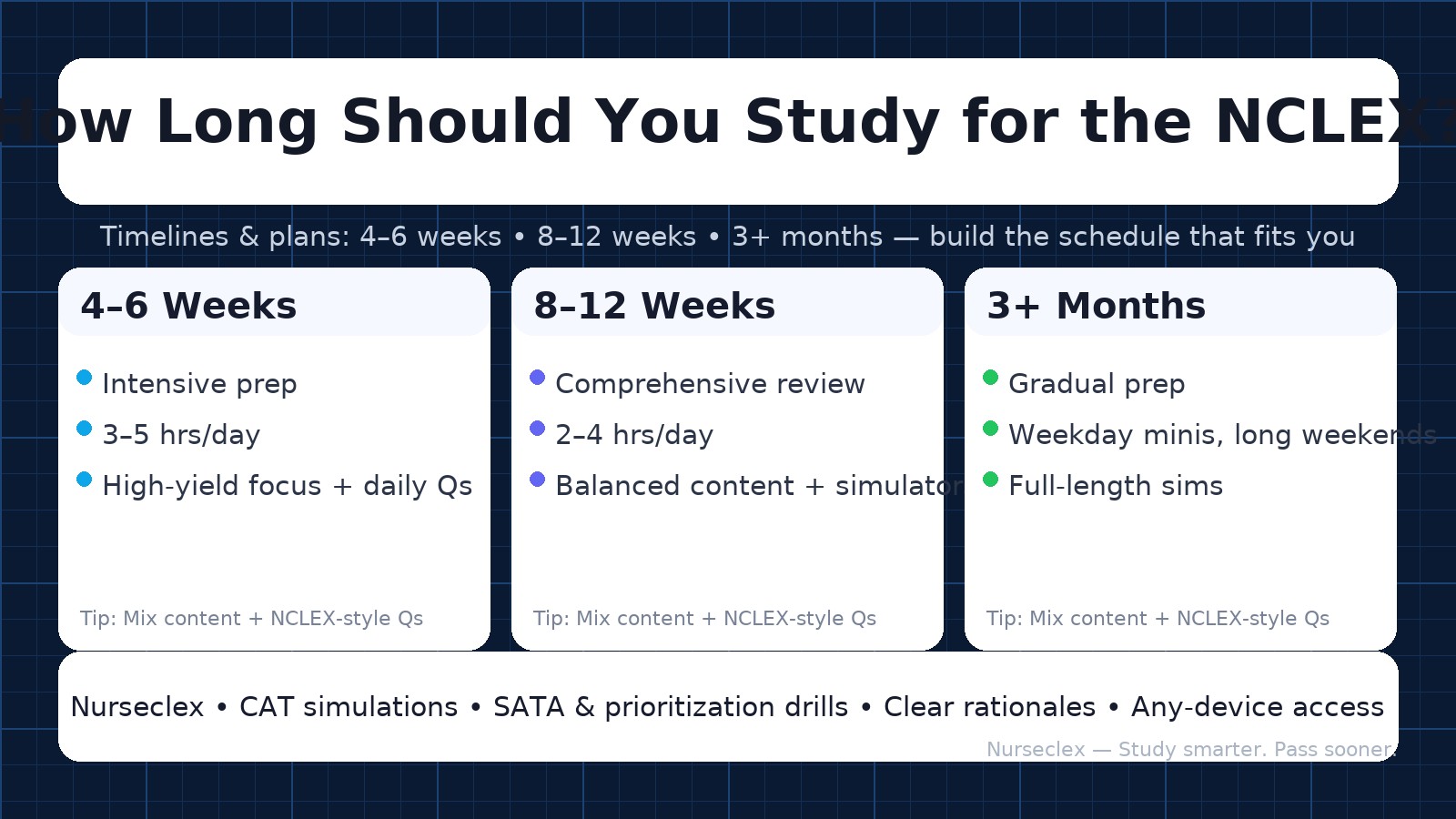
Preparing for the NCLEX is a big step, and the best prep duration depends on your background and routine. Use this guide to pick a timeline—4–6 weeks, 8–12 weeks, or 3+ months—and build a simple plan you can stick to.
1) Understand the NCLEX format (start here)
-
Computer Adaptive Testing (CAT): question difficulty adjusts to your performance.
-
Question types: MCQ, SATA, drag-and-drop, cloze, case studies.
-
What’s tested: clinical judgment, prioritization, and safe first actions.
Tip: Drill realistic items and CAT sims in Nurseclex to match exam flow.
2) Do a quick diagnostic (20–40 Qs)
Identify strengths and weak spots fast. Use that snapshot to set goals and choose a timeline.
3) Pick your timeline
A) 4–6 weeks — Intensive prep
Best for: recent grads or strong foundations.
Daily: 3–5 hours in focused blocks.
Focus: high-yield content + steady question volume.
Weekly rhythm
-
Mon–Thu: 2 content blocks (45–60 min) + 40–60 NCLEX-style Qs with rationales
-
Fri: mixed set (60–75 Qs) + notebook review
-
Sat: CAT simulation (75–125 Qs) + debrief
-
Sun: light skim or rest
B) 8–12 weeks — Comprehensive review
Best for: if you’ve been out of school or want a balanced pace.
Daily: 2–4 hours.
Focus: rotate systems, reinforce weak areas, add sims.
Weekly rhythm
-
3 system days (cardio, resp, endo)
-
2 strategy days (SATA, delegation, prioritization)
-
1 simulation day (timed)
-
1 rest/skim day
C) 3+ months — Gradual prep
Best for: work/family schedules or content refresh.
Weekdays: 45–60 min micro-blocks (content + 20–30 Qs).
Weekends: one longer practice set or simulation; review error log.
Key: consistency > intensity; protect two “non-negotiable” study slots weekly.
4) Build your plan (plug-and-play)
-
Set goals: e.g., “500 Qs this week, 2 sims, review pharm.”
-
Practice daily: always read full rationales (why safe/unsafe).
-
Close the loop: revisit misses within 24–72 hours (spaced review).
-
Track patterns: keep a 1-line “Never Again” rule per miss (e.g., “New neuro deficit → assess, then notify”).
Internal reads to slot in:
5) Stay flexible (and honest)
If pharmacology or SATA lags, tilt your schedule for 3–4 days to shore it up. Small, targeted pivots beat total rewrites.
6) Don’t neglect recovery
Sleep, hydration, and short movement breaks protect recall and judgment. Burnout lowers scores—pace yourself.
Mini checklists
Daily (30 seconds):
-
What’s today’s topic and question target?
-
When will I review today’s misses?
Simulation day (post-test):
-
3 biggest error patterns
-
1 framework to apply next time (ABCs, Safety, Stability, Time-sensitive)
-
Next study block adjustments
Fast FAQ
How long to study for the NCLEX?
Most candidates do well with 6–10 weeks of steady practice. If your foundation is strong, 4–6 weeks can work; if you’re rusty or busy, 8–12 weeks or 3+ months is safer.
How many questions per day?
Aim for 40–80 on weekdays and a 75–125 question sim on the weekend.
How often should I run CAT sims?
1 per week (two per week in your final 2–3 weeks).
Why Nurseclex accelerates prep
-
CAT simulations that mirror test logic
-
SATA & prioritization drills with clear, step-wise rationales
-
Smart tracking to target weak areas
-
Any-device access so you can study anywhere
Start your next mixed session in Nurseclex and lock in your timeline today.
Related blogs



Recent posts